
POST
Magnesium Oxide vs Citrate vs Glycinate: What’s the Difference?
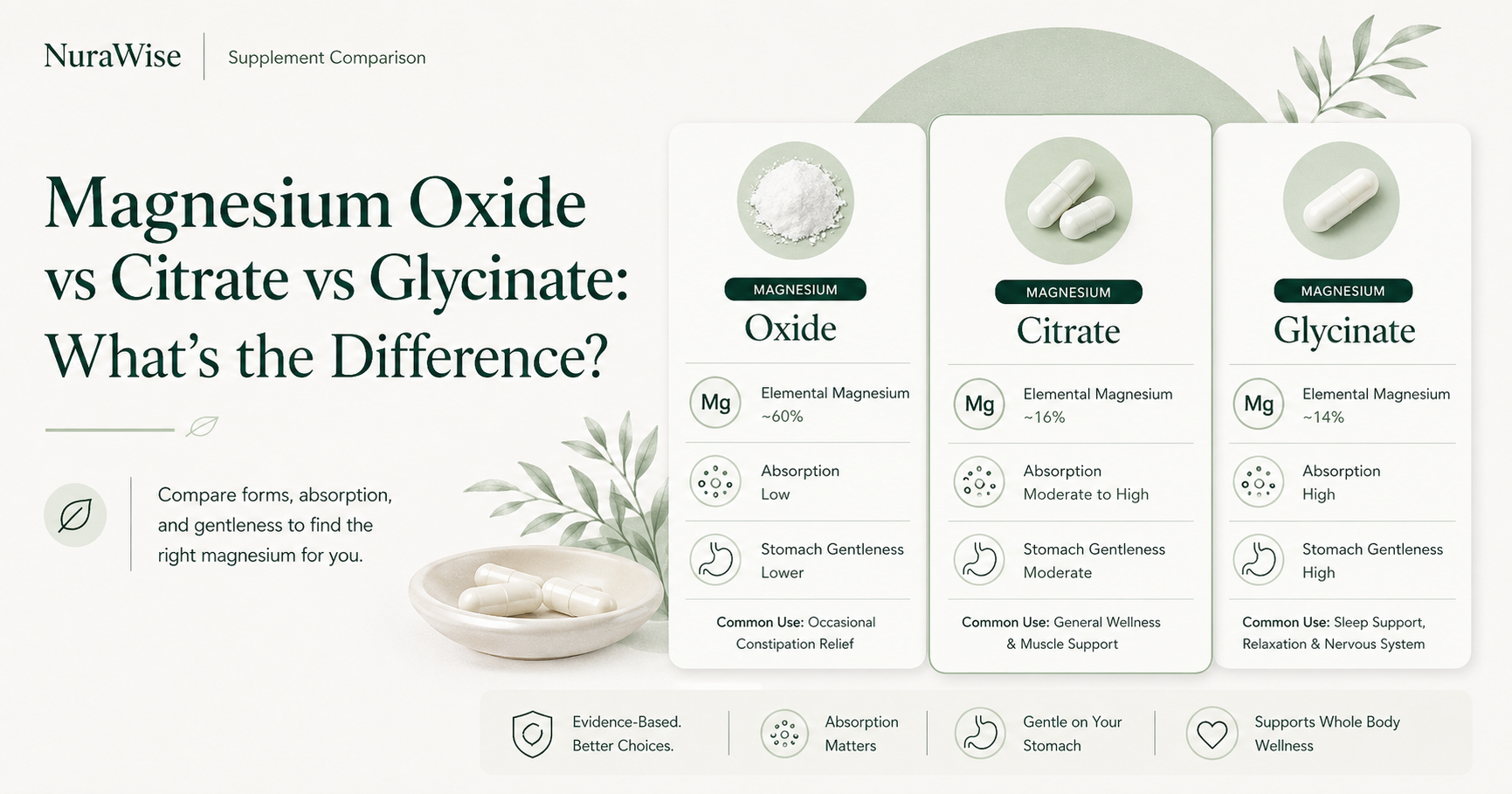
Quick answer: Magnesium oxide, citrate, and glycinate can all supply elemental magnesium, but they differ in solubility, gastrointestinal effects, pill size, and cost.
Oxide often delivers a high percentage of elemental magnesium by weight but is less soluble; citrate is well absorbed and can loosen stools; glycinate/bisglycinate is commonly chosen for better gastrointestinal tolerance.
Why Magnesium Form Matters
A supplement is not pure elemental magnesium. The mineral is bound to an oxide, acid, or amino-acid-based ligand. That changes the compound’s weight, solubility, and behavior in the gastrointestinal tract.
Three Common Forms Compared
| Form | Strength | Tradeoff | Often considered when |
|---|---|---|---|
| Magnesium oxide | High elemental magnesium by compound weight; often inexpensive | Lower solubility/bioavailability; more GI effects in some people | Cost or laxative effect matters |
| Magnesium citrate | Good solubility; widely used | Can loosen stools | General supplementation or bowel effect is acceptable |
| Magnesium glycinate/bisglycinate | Chelated; often well tolerated | Often costs more; label quality varies | GI tolerance is a priority |
Absorption: Do Not Reduce It to One Number
Bioavailability studies differ in design and population.
Soluble organic magnesium salts generally perform better than poorly soluble oxide in absorption studies, but a commercial product cannot be judged by chemical name alone.
Elemental dose, dissolution, manufacturing quality, and actual adherence also matter.
Which Form Has the Most Magnesium?
Oxide contains a relatively high proportion of elemental magnesium by weight. That can allow more magnesium in a smaller amount of compound, but high elemental content is not the same as high absorbed dose. Always use the Supplement Facts elemental-magnesium line when comparing products.
Which Form Is Gentlest on the Stomach?
Glycinate/bisglycinate is frequently selected when gastrointestinal tolerance is a priority.
Citrate is more likely to cause a bowel effect in some users. However, dose often matters as much as form: a very large glycinate dose can still cause symptoms.
Which Form Is Best for Constipation?
Magnesium citrate has an established role in laxative formulations. That does not mean every low-dose citrate supplement should be treated as a constipation medicine. Persistent constipation warrants evaluation rather than indefinite self-treatment.
Which Form Is Best for Sleep?
No form should be crowned a universal ‘best magnesium for sleep’ based on marketing alone.
Glycinate is popular in sleep products, but comparative clinical evidence proving it consistently beats citrate or other forms for sleep is limited.
How NuraWise Chooses
- First: Is supplementation needed?
- Second: How much elemental magnesium is appropriate?
- Third: Is gastrointestinal tolerance a concern?
- Fourth: Is the form transparently disclosed?
- Fifth: Is the product independently certified or otherwise quality-documented?
- Sixth: What is the cost per 100 mg elemental magnesium?
Bottom Line
Oxide can be inexpensive and compact but is less soluble. Citrate is a well-established soluble option with a greater chance of a bowel effect. Glycinate/bisglycinate is a reasonable choice when tolerance is the priority. The best product is the one that supplies an appropriate elemental dose in a form you tolerate, with transparent quality information.
Related Magnesium Guides
Editorial note: This article is for general educational purposes and is not medical advice. Supplement needs vary by health status, diet, medications, pregnancy, kidney function, and other factors. Discuss supplements with a qualified health professional when those factors apply.
Sources
NuraWise provides educational information, not medical advice. Affiliate relationships do not affect scores or rankings.